Deathly Hallows
Luca: She's reading the copyright page first.
Lilani, reading HP7: You always read the copyright page first.
Luca: Of course.
Lilani: I always do.
Luca: She's reading the copyright page first.
Lilani, reading HP7: You always read the copyright page first.
Luca: Of course.
Lilani: I always do.
You how dictionaries have all the words alphabeticalised? Not so with cookbooks. Some cookbooks (members of what we'll call the 'annoying, but passable' variety) have the recipes arranged by type of food: Breads, cakes (turns out Marie Antoinette was right), cookies, pastas, meats, vegetables, soups, and so on. Now, I think cakes, cookies, and pastas are all breads. I'm also under the impression that some recipes mix multiple ingredients, such as pork (meat) and beans (fruit, but categorised, no doubt, by these books as a vegetable). Still, if I want to make lasagne, and there's a pasta section, I can guess where to look.
Other cookbooks like to arrange the dishes by when the author thinks you should eat them. Breakfast, lunch, snack, supper, or dessert. Usually I can probably guess whether a type of cake is considered by the author to be a snack or a dessert (though I haven't tried), but are hod dogs lunch or supper? Are all cookies snack, or are some dessert? And why the hell does this old bat think it's her place to tell me I can't have pancakes for lunch or pizza for breakfast? Or roast beef for lunch, for that matter? When I make a list of people who should be making that decision, it comes to one person, and his name's not Betty.
'But, ah!' you might say. 'Ah! These books have indexes! Indexes are alphabetical!'
'Tis true. The index is alphabeticalised. But by this I mean 'Pasta' comes after 'Meats'. The index oftentimes is no flatter than the contents itself. Lasagne still comes after Sugar Cookies.
You might think this is what we refer to as a 'Table of Contents'? No, the TOC is at the front of the book and lists only half the sections. I don't mean, 'Only H2 and H3', but 'Only H2 and some of H3'.
There are only three ways to cook: Know what you're doing, trial and error, and Google.
I mostly cook for people who would dislike my taking the second route, so I tend to use Google.
(In the textarea, 'use Google' is wrapped onto its own line and makes me wonder what amazingness such a package could do. Prolly just an interface to the web search. Bah.)Almost forgot: When you finally do find the lasagne recipe, it assumes you already have pre-cooked noodles. No, dumbass, you're supposed to tell me HOW to cook the damn things. Luckily, my brother noded it years ago.
I love pretty much everything Diana Wynne Jones has written, but I never understand the review snippets they put on the books. 'Laugh-riot'. 'Uproariously funny'.
I'm not sure that I've ever laughed while reading her books. They're amusing at times, but do you really laugh out loud when reading them?
To my mind, Gordon Korman is funny and Diana Wynne Jones is just brilliant. Explain how Jones' funny. I want to understand. Show me a line or a scene from one of her books that made you laugh aloud.
I just thought I oughta mention that for my NaNoWriMo, I have a separate blog. It's full of wit and wisdom and cleverness and nothing at all really, but just let me dream, okay?
Science fiction from before we went to the Moon can be fun.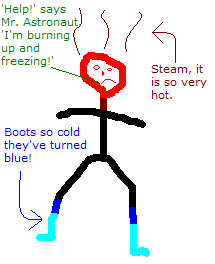 In Poul Anderson's 1957 short story 'The Light'1, the astronauts have cold feet.
I'm not saying that they're scared. It's their feet. In the story, the astronauts are very warm at the top of their spacesuits, as very little heat escapes via radiation, but very cold at the bottom, because the freezing Moon surface rapidly sucks the heat out through the soles of their shoes. Major heat gradient goes on inside.
Now, I personally have never been to the Moon--my vials froze and exploded at an altitude of several thousand feet--but I'm fairly confident this isn't how it is. Still, it's a brilliant insight on the part of the author. It's things like this that make me understand why scifi is so geek-loved. I often find scifi novels boring, but the authors think, and come up with some very artful concepts.
Of course, it's not all genius. One children's scifi series I enjoyed when I was young was Jerome Beatty Jr.'s Matthew Looney series. The Looney's were a family of Moon-dwellers.
On the Moon, people had to walk a special way. Otherwise, they'd find themselves hovering ten(?) feet off the ground for a few hours before finally settling back down to the surface. Low gravity, you know? However, when the Moonfolk visited Earth, the planet's gravity was so strong that they couldn't move at all unless they had their personal anti-grav units.
At one point, Maria Looney--I think it was her--was launched high into the Moon's sky, and oh my goodness! She couldn't breath. Luckily, she floated back down nearer to the surface quickly and was able to fill her lungs with 'atmos'.
(Sidenote: The Moonfolk were very wasteful. They used each article of clothing once, after which they'd be converted into Moon dust and used to fill craters. They were shocked to discover Earthlings use the same clothing over and over again.)
1 Poul Anderson, THE LIGHT © 1957 by Galaxy Publishing Corporation. So says 13 Great Stories of Science Fiction, edited by Groff Conklin, which is where I read it.
A book by Brigid Brophy, Michael Levey, and Charles Osborne.
I haven't read it, but I've read the E2 node a few times. Summary: here're fifty books that have been parodied and rehashed and made tribute to so many times that we recognise any references to them without needing to read them.
Is it true? I don't know. /Hamlet/ is on the list, and you don't need to have read that to be very familiar with it, but I don't recognise many of the titles on the list. I guess its about their being alternate works to which to redirect the references, not there being common knowledge about them.
That's all. I just felt like posting something here, and that's what I came up with. Sorry.
Got a new kids book yesterday. It's about voting. It tells what voting is; it tells why we should vote; it tells about debates, and campaigning, and so on. It does one thing right: it tells us that kids can vote. Kids can vote by helping out in campaigns, says the book. Okay, I'd have said by writing letters to the editors and Reps and Senators, but that's good too.
But it also tells about how originally in the US, blacks, women, &c weren't allowed to vote and it took ages for us to get it together. Now, says the book, everybody citizen over the age of eighteen can vote.
If you had asked people during the 1890s if every citizen could vote, they'd probably have said 'yes', completely forgetting about the women. If you'd asked in the 1830s, they'd have said 'yes', forgetting all about the blacks. Now, we say 'yes', because we forget about convicted felons.
Whether convicted felons should be allowed to vote can be debated, but a convicted felon is legally a US citizen and is not permitted to vote in some stated. The author should have realised this. So should have her editor.
I've been reading Patricia McKillip's Riddle of Stars recently, because one McKillip site compared her to Wrede, and I like Wrede.
McKillip is not bad. I mean, once I got some way into the book, it was pretty good. But she has the most incredibly pretentious writing style I've ever seen. It's like she read the Christian bible or something and decided to imitate its style. As he drew out the crown, the great center stone, colorless itself, groping wildly at all colors of the room, snared the gold of Rood's robe and blazed like a sun.
That is far from the longest sentence in the book, and actually not a particularly distinguished one. But sometimes she gives nice short ones. Like this: Morgon picked up the crown, turned it in his hands.
Good book, if you can overlook the writing.
