Showing posts with label science. Show all posts

Saturday, June 21, 2008

'Do you agree with the statement "Everything happens for a reason"?'

Usually this question is religious in nature, and I disagree with it in terms of religious reasons, so 'no'.

But obviously things have causes, so 'yes'. I don't want sciency people interpreters taking my answer to mean I'm not sciency.

But quantum mechanics suggests things happen without causes, right? So 'no'.

Yes => I sound religious, and therefore unsciency.
No => I sound unreligious, and therefore sciency, but also unclassicalsciency. Will the sciency people interpreting my answer think to consider quantum mechanics?

By the way, 'karma' literally means 'cause and effect' (or perhaps just 'cause'), which I strongly believe in, and my friend's daughter is named Karma, whom I also am fairly certain exists. So do I believe in karma? I think there are causes, yes. I don't think there are mystical connections wherein doing bad causes bad things to happen to you, especially seeing as I am a nominalist and don't buy into wide content.

These questions seem simple to you simple-minded people, but they're not.

Saturday, February 09, 2008

People are often complaining about the 'anti-science' attitude so prevalent in the US, but let's look at some scientific 'facts' and see how they stand up against basic common sense or simple tests:

Spherical Earth

Obviously false. I set out walking in a straight line, for more than an hour, and I didn't return to where I started. Additionally, I have friends who have been to the so-called 'Southern Hemisphere' and they told me people walked on the ground, feet down, just like here.

Wave-particle duality

I don't even need to go into this. It's simply absurd. I mean, come on!

Consistency in the speed of light

Again, WTF?

Heliocentricism

I can bloody well see the Sun going around the Earth.

Atomic theory

You're telling me I just stubbed my toe on a rock that's mostly empty space? Bull. Crap.

Relativity

Things bend. Space is not a thing. It's where things are. And time is time.

Quantum Mechanics

Atomic theory on crack. In Vegas.

Rocks and feathers falling at the same distance in a vacuum

Hello! One's heavier than the other!

It's no wonder science isn't trusted. They don't even try to come up with half-way plausible claims.

Tuesday, November 20, 2007

Person how are the people in antartica not upside down?
Person [States his name because multiple people use the account.]
Luca Consider the definitionof 'down'.
Luca We use a spherical coordinate system.
Person but the people are on the bottom of the earth.
Luca Now consider the definition of 'bottom'.
Luca You've switched frames of reference.
Luca Down is toward the centre of the Earth, not toward the South Pole. Do you consider yourself to be sideways?
Person and why arent we sliding off the earth?
Luca Because there isn't a super-massive black hole just south of the Earth pulling on us but not the Earth.
Luca See, here's the thing: the Earth has mass. zOMG!
Person no. but looking at a globe makes it confusing.
Luca Yeah, if you're from the middle ages.
Person i still dont get it.
Luca How old are you?
Person 16. im just a bit... slow. besides no teacher has ever explained this. they just tell us that the worlds not flat.
Luca You've heard of gravity?
Person nevermind i get it now.
Luca And I was just about to draw you an illustration.
Person yeah. i get it now. since gravijy is from the center of the earth everything works out.
Person awww man. i want to see an illustration. i dont get it anymore
Luca http://lkbm.ecritters.biz/blog/gravity.png
Luca Down is defined as the direction the arrows point.

Wednesday, July 18, 2007

(Potentially relevant link)

Before the cold fusion debacle, what did we use as the quintessential example of bad science?

One noder claims it was Dr. James McConell's experiments at the University of Michigan. Specifically, Dr. James McConell would have planarian worms run a maze. Once they were trained he chopped them up and fed them to some other planarian worms. These cannibal worms were then able to run the maze better than non-cannibal worms, or so McConell claimed. These results, however, were never reproduced.

What a surprise.

Monday, May 28, 2007

Philosophers came up with ID a couple thousand years ago, and it's been revisited many, many times. I first heard of it many years ago under it's traditional name 'The Watchmaker Analogy'. In short:

You're walking out in the desert and you find a golden pocket watch with lots of little gears and everything inside and it keeps perfect time. 'Amazing!' you say. 'A pocket watch has randomly formed from the sand!'

This seems absurd. A reasonable person assumes there's a watchmaker who created it, because it's a really complicated thing and it would be stupid not to assume that it was created by an intelligent being.

So too is it with the universe.
This is a really good argument. That's right, ID is good. ID is a brilliant philosophical argument that we've been teaching in philosophy courses for hundreds of years. Because it's a most excellent argument for the existence of god.

But here's the thing: ID is a brilliant philosophical argument that we've been teaching in philosophy courses for hundreds of years. Do you see the words 'science' or 'scientific' in the previous sentence? No, because ID is a brilliant philosophical argument. Not science. No one for a second considered this science until very recently when the religious fanatics needed a new way to force their philosophical views into science classes. It hasn't changed. What makes something science hasn't changed. Only one thing has changed about it recently: politicians decided they needed to declare it science to push their own agenda.

That's not cool.

Science is science (thank you, Aristotle!) while philosophy is not (though it keeps spawning sciences).

* ID is not based on empirical evidence. (That the universe is complex?)
* ID doesn't give us any predictions about future observations. (If we continue to examine the universe, we'll continue to see that it's complex? We're going to find the designer if we look over in that star system?)
* ID is not falsifiable. ('Oh, we were mistaken: the universe actually isn't complex'?)

Actually, one thing has changed other than the politicians: science has shown that ID doesn't really apply to the main things we thought it did: life. Yeah, the universe is pretty complex, but we now have proof that there is a simple working mechanism by which complex things arrive from simple ones. Higher lifeforms don't need an intelligent creator. They just need lower lifeforms. And the lowest lifeforms are simple enough that they don't need a creator.

Monday, April 30, 2007

The ISS is nice, I suppose. But what do they even do up there on it? Do you know? I don't know. It's probably useful stuff. Learning more about long-term space habitation is always good.

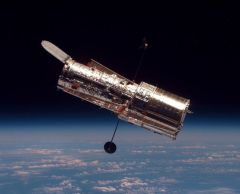
The Hubble Space Telescope

The Hubble Space Telescope (image from NASA)

But what I do know is what the Hubble Telescope does: it gives us enormous amounts of information about the universe by showing us detailed visuals we otherwise wouldn't have. It helped is measure the Hubble constant much better, it taught us about black holes, galaxies, the early universe, future universal expansion, extrasolar planets, nearby planets and what happens when a comet crashes into a planet... Hundreds of important papers have been published based on images from Hubble Space Telescope.

Second to going to the Moon, this thing is probably NASA's greatest success, and that's pretty darn good. Did we go to the Moon once and then say 'Okay, that's all'? No, we went back again and again, because we were still learning new stuff. Eventually we stopped. The budget was shrinking, probably because it got to be old hat in the eyes of many Americans. The alternative would have been to kick it up a notch: build a base, head on to Mars, or, oh!, how about putting a big telescope on the surface of the Moon? No atmosphere there, eh? But, no. We let that die for the time being. Moved on to other things. Such as the Hubble Space Telescope.

That they want to let the telescope die isn't what bothers me. I can't even grok that bit of news. What irks me is that they haven't sent up an entire array of more powerful orbital telescopes appals me. It's time to kick the Hubble Space Telescope up a notch. It's still giving us good information, but it can only point in one direction at once, and there's a lot of stuff out there for us to study. Let's build some more telescopes and start looking around. (Can't afford it? We could stop so many things like the B-2 Spirit [2 100 000 000USD a pop])

Friday, April 27, 2007


A pile of cinderblocks
The mission: investigate the claim that the Great Pyramid of Giza is roughly 146 meters tall.
The method: In the famous Mythbusters tradition, I will attempt to replicate the feat myself. If I don't succeed within ten minutes, the myth will be busted.

Step one: I'll take the blocks from there and pile them over here.

A cinderblock pyramid
After roughly fifteen minutes of non-stop construction, my pyramid is as big as it's going to get. The time limit has been reached.

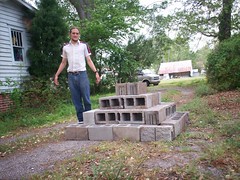
Luca Masters sitting atop his cinderblock pyramid.
I've never visited Egypt, but I imagine it must be something like this.

Luca Masters next to his cinderblock pyramid.
Alas, after fifteen minutes of construction, the pyramid is not even two meters tall. This proves conclusively that if the Great Pyramid of Giza exists, it's a lot shorter than people claim. Probably just a lie the Egyptian Ministry of Tourism likes to spread.


Wikipedia claims that the Great Pyramid of Giza stood 146.6 meters tall when the Egyptians built it in 2570bce.

Convinced this was a myth, I headed outside and attempted to construct such a pyramid of my own. After over ten minutes of trying, however, my attempt at a perfect replica was still under two meters heigh. Thus, we now have scientific proof that the Great Pyramid of Giza does not exist, or that if it does, it's a lot shorter than they claim.

Another myth busted. Now where's my tv series?
 

Saturday, March 03, 2007

OMG, it's awesome! I can't see the Moon at all!

Yes indeedy, all those clouds eclipse the Moon really, really well.

Monday, October 02, 2006

If you get caught in a vacuum, your blood boils and things explode, correct? But suppose you're not quite caught in a vacuum. Suppose you're flying along in your lovely rocketship with 1-inch thick walls and some big lug flies by and pokes a small hole in your hull. Obviously you'd wan to stop up the hole through which all your oxygen is leaking, as is the lovely smell of those chocolate chip cookies you just baked. So thinking quickly, you stick your thumb in the hole.

Does your thumb explode? Do the capillaries burst and you begin to lose blood at an alarming rate. (And if so, how many cookies must you eat per minute in order for your body to have enough sugar to replace the lost blood. How many litres of soy milk must you down with these cookies to replace the lost fluid that is literally and non-metaphorically the life-blood of your circulatory system? If you pull your thumb out and stop up the hole with a cookie-crumb-covered napkin, will your thumb recover, or will it be a bloody mess for the rest of your life?

Clearly, this is unhappy. So perhaps instead of sticking your thumb in the hole, you merely press it against the hole. Will the skin explode but the rest of the thumb still manage to block the air's escape? Will your new lack of a thumbprint on one hand lead you down the dark path of criminal behaviour?

If any of you happen to have a vacuum you can test with, please do so. However, because we'll be wanting your results typed out, you'd best do the testing on a toe rather than a thumb.

Wednesday, September 27, 2006

Science fiction from before we went to the Moon can be fun.

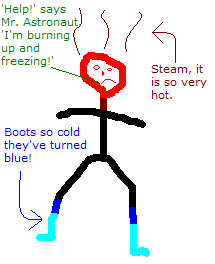
A stick-figure astronaut with blue feet and a red head (and red stream rising). '"Help!" says Mr. Astronaut. "I'm burning up and freezing!"'In Poul Anderson's 1957 short story 'The Light'1, the astronauts have cold feet.
I'm not saying that they're scared. It's their feet. In the story, the astronauts are very warm at the top of their spacesuits, as very little heat escapes via radiation, but very cold at the bottom, because the freezing Moon surface rapidly sucks the heat out through the soles of their shoes. Major heat gradient goes on inside.
Now, I personally have never been to the Moon--my vials froze and exploded at an altitude of several thousand feet--but I'm fairly confident this isn't how it is. Still, it's a brilliant insight on the part of the author. It's things like this that make me understand why scifi is so geek-loved. I often find scifi novels boring, but the authors think, and come up with some very artful concepts.

Of course, it's not all genius. One children's scifi series I enjoyed when I was young was Jerome Beatty Jr.'s Matthew Looney series. The Looney's were a family of Moon-dwellers.
On the Moon, people had to walk a special way. Otherwise, they'd find themselves hovering ten(?) feet off the ground for a few hours before finally settling back down to the surface. Low gravity, you know? However, when the Moonfolk visited Earth, the planet's gravity was so strong that they couldn't move at all unless they had their personal anti-grav units.

At one point, Maria Looney--I think it was her--was launched high into the Moon's sky, and oh my goodness! She couldn't breath. Luckily, she floated back down nearer to the surface quickly and was able to fill her lungs with 'atmos'.

(Sidenote: The Moonfolk were very wasteful. They used each article of clothing once, after which they'd be converted into Moon dust and used to fill craters. They were shocked to discover Earthlings use the same clothing over and over again.)

1 Poul Anderson, THE LIGHT © 1957 by Galaxy Publishing Corporation. So says 13 Great Stories of Science Fiction, edited by Groff Conklin, which is where I read it.

Saturday, September 23, 2006

We all want a way to send people to the Moon. We did it in the sixties and the seventies, but not since then. And yet over the past few years, numerous people whom we really don't want on Earth have cropped up, both in politics and entertainment. So what we need is a new plan for getting people to the Moon. Several concepts worth considering exist:

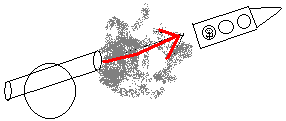
A crappy stick diagram of a spaceship being fired from a cannon.One distinguished author had the thought of launching the spaceship from a cannon. This has the benefit of not weighing the ship down with tons of fuel. It has the disadvantage of extreme acceleration--enough to kill the passengers--and (assuming you aim well) extreme deceleration--enough to squash or bury the passengers upon arrival.

A large blue ball (Earth) connected to a smaller grey ball (the Moon) by a wavy line. This ia a crappy diagram of a space elevator to the Moon!Another method worth considering would be to build a bridge. Space elevators are talked about a lot, but if you really want something useful, you should make a space elevator going all the way to the Moon's surface.

This idea, however, has the disadvantage of disrupting the Moon's orbit around the Earth or the Earth's rotation. While I wouldn't mind longer days, I would object to the Moon being pulled apart by sudden deceleration and then falling on our ambitious heads.
Of course, this can easily be avoided. Most space elevator designs are flexible, and many have movable bases. All we need is a full track around the Earth's surface so the base can follow the Moon. (Gravity has slowed the Moon's rotation to match it's revolution, so we can fix the point it attaches to the Moon.) We'll also need some stretchiness, as orbits are elliptical. We'll keep this as a backup plan.

A crappy stick drawing of an uphappy guy standing below falling shards of glass.There was also an idea from a clever French poet noted for his oversized proboscis. He figured that in the morning, dew rose from the ground up to the Sun. So he figured we could fill a bunch of vials with dew, attach them to our hapless spaceman, and watch him float up into the sky come morning.
In his outline for this plan, however, he predicted a small problem. The astronaut found himself going too far (keep in mind the dew goes to the Sun, not the Moon) and had to break the vials to stop his ascent.
I'm sure I don't have to point out to you the dangers of shards of glass raining down from the upper atmosphere or beyond. This plan should be only used as a last resort, and only if we have force shields to protect us from deadly glassrain.

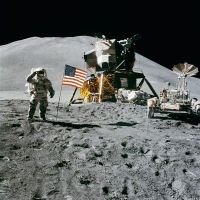
A public domain photo of Apollo 15 on the Moon's surface, with the flag flying and a saluting astronaut. The Moon Lander and Moon Rover to the right.Lastly, there's the option of reviving the methods used by NASA. These, however, have the politically unpopular characteristic of being based on actual science, something the jury is still out on.


Monday, July 31, 2006

Juan Tripp Airline decides business people are both richer and more likely to want to return home on Friday, while the cheaper vacationers are happy flying home on the weekend. So they charge more for the Friday return flights. Bob Vacationer, however, is both cheap and works weekends, so instead of having his lovely consumer-surplus-filled vacation, he has to stay home and watch Monty Python DVDs.
Result: inefficiency/waste caused by price discrimination.

The textbook and Wikipedia articles I've read never seem to mention this--though I'm sure it's covered somewhere in papers and cleverer textbooks. Does competition deal with this somehow? I guess it must not or else we wouldn't have imperfect price discrimination, eh?

Tuesday, January 04, 2005

(Potentially relevant link)

Were we to create an instance of the ninth gluon, would containment be destroyed, thus colouring the Universe, and allowing strong nuclear force to supplant electromagnetic force as the dominant force in the Universe, and in turn destroying all life in the Universe? (Just curious. . .)

And if it would, should we try anyway? I mean, it would probably suck for us to all die, but imagine the coolness factor.

Of course, maybe it wouldn't do any of this. Such a result would not be wholly unprecendented.

(I'm dreadfully uninformed about most physics.)

Friday, December 24, 2004

A kid asked me what mass was. Just out of the blue.
I tried to explain. It's just the measure of matter, as height and weight are measures. But how is it different from weight, they want to know.
At this point, it gets strange. Insofar as weight!=mass, the distinction is that mass is how we think of weight and weight is something much more complicated. We're all backwards. It's silly that a six-year-old knows what weight is--in a rough intuitive sense--but not what mass is. We should stop talking in terms of weight. I don't care that I weigh 63KG at the Earth's surface, or that the bag of salt I'm buying weighs 80LB at sea level. What's actually relevant is how much of me or of salt there is. The mass. (Actually, according to Wikipedia, in commerce, 'weight' means mass. So use the term 'mass', darn it!)
Instead of having kids grow up possessing (or thinking they posess) an intuitive sense of what weight is and only teaching mass in science class, they should grow up with an intuitive idea of what mass is, and weight should be a weird scientific concept discussing relations of gravitational fields, which are caused by mass.

Maybe once we colonise other planets we'll switch. But I doubt it. Few would hesitate to say the Sun rose this morning, after all.

Thursday, October 07, 2004

Yesterday, someone posted this on one forum I read and participate in regularly:

Miss Bitters: When I was your age I wanted to be an astronaut. Then my ship imploded in the vacuum of space. The lesson here is that dreams inevitably lead to hideous implosions.
I, for one, had never realised the danger the Casimir effect presented was so great. This, I suppose, is why one should be careful that ones dishes never get to close together during flight.

Monday, January 26, 2004

One person on a site I use has 'assembled physics notes' for all high-school students 'despite being only thirteen'. Here's one nice gem:
What does E=MC^2 mean?

Energy=Matter traveling at the (speed of light Squared)

or even more simply.

if matter was to trasvel at the speed of light squared
which can be calculated like this
186000 Km/h * 186000 Km/h=34596000000 Km/h
it would turn into energy