
Monday, July 30, 2007

Suppose you're walking down the street in Dallas when you're approached by a guy who looks as if he hasn't shaved or showered in thirty years. 'Kennedy was killed by Alaskan coal miners!' he tells you.

You, being an open-minded person with nothing better to do, ask him how he knows. He proceeds to show you charts and diagrams and reams of print-out supporting his claim. You study the data carefully for a bit and come to the following conclusion: 'It's possible, but very unlikely.' The evidence just isn't that strong. It's weak enough, in fact, that you'd withhold judgement even if it didn't seem an extraordinary claim to you.
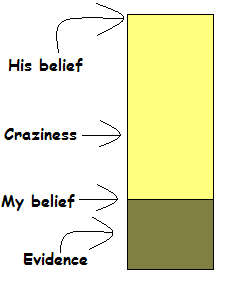
A chart showing evidence up the level of my belief and craziness on top of that up the the level of his belief.
'This isn't entirely convincing', you tell the guy. 'Any other evidence?'

'No, this is all I have. But I'm dead certain it's true.'

Now here's the thing: the evidence supports a belief of strength 'possible, but unlikely', so that's the belief you've formed. The evidence is a far cry of supporting a belief of strength 'dead certain', yet that's the belief this guy has formed. There's a huge gap between the evidential support and the guy's certainty. What is it in that gap?

You look at the guy and it immediately becomes clear: craziness.


The next day, you're out for a walk and a guy comes up to you and says 'God exists! Here's proof.' And he shows you the Bible, historical evidence of apparent miracles, claims from seemingly-sane people who say they felt God, and so on.

You study the evidence carefully for a bit and come to the following conclusion: 'It's possible, but very unlikely.' The evidence just isn't that strong. It's weak enough, in fact, that you'd withhold judgement even if it didn't seem an extraordinary claim to you.

'This isn't entirely convincing', you tell the guy. 'Any other evidence?'
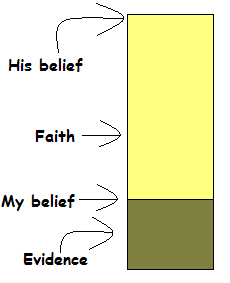
A chart showing evidence up the level of my belief and faith on top of that up the the level of his belief.
'No, this is all I have. But I'm dead certain it's true.'

Same situation as before: the evidence supports a belief of strength 'possible, but unlikely', so that's the belief you've formed. The evidence is a far cry of supporting a belief of strength 'dead certain', yet that's the belief this guy has formed. There's a huge gap between the evidential support and the guy's certainty. What is it in that gap?

You look at the guy and since he's clean-shaven it immediately becomes clear: faith.

Now here's the thing: that's just stupid.

Faith is obviously a synonym for craziness. They both mean 'the non-thing filling in the space between the evidence and the strength of belief.'

Sunday, July 29, 2007

Two fortune cookies with lunch today:

:-) You have an unusually magnetic personality. :-)

Magnets. Whoohoo!

24 29 11 26 2 9

Three primes and a square. Mediocre.

Speak Chinese
four hundred si bai

I don't know how to get the tonal marks or kanji.


:-) Birds are entangled by your feet and men by their tongues. :-)

What?

28 18 43 44 30 51

One prime and my favourite perfect. Meh.

Speak Chinese
very well hen hao

Not 'very good'. Know the difference.

Friday, July 27, 2007

This rule from Perl Best Practices made me laugh and finally realise what twisted, sick-minded individuals Perl programmers really are.

The correct rule is obviously 'Don't cascade ternary operators. Just don't. Use if-else.' But Perl programmers do it our way, and it's as beautiful as it is evil.

Wednesday, July 25, 2007

In the array and hash naming convention guideline in Perl Best Practices, they have this lovely example of when an array name should be singular (answer: when used as a random access table like a hash):

sub factorial {
my ($n) = @_;

croak "Can't compute factorial($n)"
if $n < 0 || $n > $MAX_FACT;

return $factorial[$n];
}
Factorials not pre-calculated for the cache are simply declared incomputable. Talk about lazy programming!

(Code snippet from:
Perl Best Practices, by Damian Conway, Copyright 2005 O'Reilly Media, Inc., ISBN 0-596-00173-8
Good book.)

Monday, July 23, 2007

'Best seafood in town' -- Sign in front of the only seafood restaurant in Chocowinity.

Saturday, July 21, 2007

Luca: She's reading the copyright page first.
Lilani, reading HP7: You always read the copyright page first.
Luca: Of course.
Lilani: I always do.

Wednesday, July 18, 2007

(Potentially relevant link)

Before the cold fusion debacle, what did we use as the quintessential example of bad science?

One noder claims it was Dr. James McConell's experiments at the University of Michigan. Specifically, Dr. James McConell would have planarian worms run a maze. Once they were trained he chopped them up and fed them to some other planarian worms. These cannibal worms were then able to run the maze better than non-cannibal worms, or so McConell claimed. These results, however, were never reproduced.

What a surprise.

Monday, July 16, 2007

Roads change names

Okay, we have this in Greenville, NC too. Until a few weeks ago, 5th changed into Martin Luther King Jr., but for the most part, if you don't leave the main road, you won't find yourself on a completely different road.

Roads reuse names

I'm on Clairemont. Why am I passing Clairemont? Holy Toledo!, there it goes by again!

Apparently, some fool decided that Clairemont Rd. wasn't enough. It crosses Clairemont Terr. and at least one other Clairemont. And Clairemont isn't the only road like this. They all have multiply-redundantly named roads.

In Greenville, Charles Blvd. crosses Charles St. That's bad enough for Greenville. Atlanta knows no reasonable bounds.

Roads aren't continuous

Example. Look at Ralph McGill west of Carter's lovely place. But, wait: you're standing on Linwood north of the Carter Center and looking a sign that says it's the intersection of Linwood and McGill! Is Google Maps horrible mistaken?
No, Google Maps is entirely correct. Zoom in one dit and you'll see a short, unconnected-to-the-other-McGill McGrill that touches Linwood. Bloody Hell.

Now, we have this in Washington, NC. Market Street is an arrogant bastard and if you're driving down 6th, you'll have to turn onto Market and go perhaps twenty metres before turning back onto 6th. It sucks. A lot. But at least it's trivial to go between the two.

Excuse me sir, do you know which direction [non-trivial road a couple blocks away] is?

'Sorry, I'm not from around here.'

You wouldn't expect to hear this from three people in a row, but apparently everybody in the vicinity of Clairemont Rd.and N. Decatur Rd. commute from who-knows where, and those that think they do know where things are give you false information.

You know who doesn't suck? One lonely Emory student. Only person with the guts to tell me 'No, Houston doesn't connect with Decatur.'

He told me the way to Lavista Rd. and how to get to Houston from there. Why the fuck didn't someone tell me 'Just fucking go to Lavista. We don't know any other way to get to Houston'?

This is something that doesn't happen where I live. I was once asked how to get somewhere and I knew the answer--me!

Other reasons

I'm sure I could come up with some. Hills at some places. I'm not an expert at driving a standard.

Monday, July 09, 2007

I was going to post about the hawk, but it was a boring story. Basically: hawk want birds in cage. People not want hawk to get birds. I stare at hawk and move the cage he's sitting atop. Hawk not kill me.

Happy ending!

Saturday, July 07, 2007

Math professors are always telling their students that math is useful outside of the classroom and is needed in many aspects of normal life.

Then the students go home and see that their stupid parents don't know algebra or trigonometry or much of anything beyond basic arithmetic, yet manage to get through life all right.

So the student correctly assumes they don't need math. They also assume math is useless in ordinary life.

Stupid students.

You know how a few years ago Wal*Mart started posting cost per ounce beside the price of food items? Useful! Now you can easily compare different-sized items. I, however, learned from my dad years and years ago to do that myself. It requires division.

This is why your math professor says he uses math in daily life and your parents say they don't. Your parents went without the cost per ounce information before Wal*Mart gave it to them pre-calculated and it never even occurred to them to calculate it themselves. The math professor saw the opportunity to use math, and so he saved money. There are also many cases where more advanced math is useful, but not required and people who don't know them don't realise there's an opportunity being missed.

If you didn't know how to read, you'd find everyday life a challenge, because society expects people to know how to read. The benefit of being able to read is obvious, because important uses of reading are everywhere. Society doesn't expect you to know basic algebra, so getting through life without it is easy, and you won't even notice the missed opportunities to save money or time.

That's not because your math professor is lying about it's usefulness. It's because you chose to remain blind.

(Math people: please post good examples of using algebra, trigonometry, set theory, probability, combinatorics, calculus, etc. in Regular Life. We need a massive database to show the 'math is useless' crowd.)